
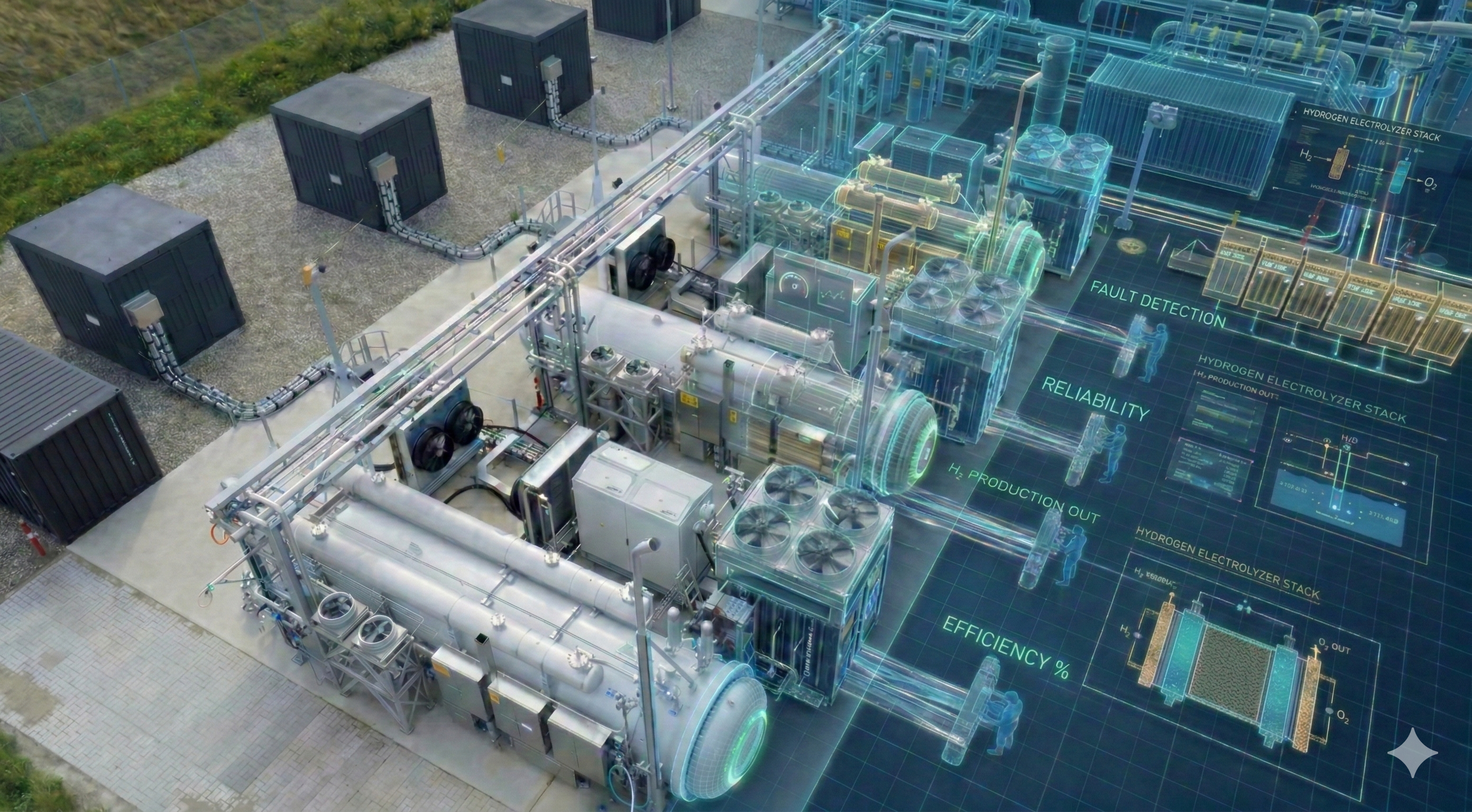
Digital twins and artificial intelligence are fundamentally changing the way we design, operate, and optimize fluid systems - ranging from water distribution and pumps to reactors and wind turbines. Where traditional practice relied heavily on steady-state assumptions, empirical correlations, and offline testing, we’re now empowered by real-time models and data-driven insights that enable us to predict behaviour, diagnose issues, and continuously improve performance.
This seminar delves into the integration of Digital Twin and AI technologies in fluid mechanics, with a special focus on physics-based modelling, data assimilation, and machine learning for monitoring, control, and decision support. We will explore hybrid approaches that combine first-principles models with AI like reduced-order models, surrogate modelling, and physics-informed learning and discuss practical deployment in industrial settings.
Industry and academic experts will share methods, tools, and case studies on creating and operating fluid-mechanical digital twins, applying AI for soft sensing and anomaly detection, and using hybrid models for real-time optimization and control. Presentations will demonstrate how these technologies are helping to reduce time-to-decision, boost reliability and safety, improve energy efficiency, and enable more resilient, data-driven fluid systems.
Preliminary Agenda of the day
| Time | |
|---|---|
| 09:00 | Registration and Coffee |
| 09:30 | Introduction and motivation |
| 10:15 | Scientifc Machine Learning for Computational Fluid Dynamics Allan Peter Engsig-krarup, DTU Compute Computing has become a central pillar of scientific inquiry, enabling large-scale simulation and analysis that complement theory and experiment in shaping modern science and engineering. Today, the increasing complexity of systems and the growing availability of data has led to widespread interest in data-driven methods. However, conventional data science techniques often overlook the underlying physics and struggle in regimes where data is limited, biased, or unrepresentative—conditions common in many scientific and engineering applications. Scientific Machine Learning (SciML) addresses these challenges by integrating domain knowledge and first-principle models with modern machine learning. This hybrid approach enables physically consistent, data-efficient, and generalizable models, unifying simulation, modeling, and data analysis rather than replacing one with another. SciML is inherently interdisciplinary, requiring collaboration across applied mathematics, computer science, and domain sciences. This talk will motivate the need for SciML in current and future engineering workflows, and give a few highlights that illuminate techniques of SciML and include some recent research examples demonstrating some of the potential capabilities and opportunities across scientific and engineering domains such as Computational Fluid Dynamics (CFD). |
| 10:30 | Coffee break |
| 11:00 | PhD Jens Visbech |
| 11:30 | Physichs based machine learning for alkaline electrolyzer application Katrine Bukh Villesen & Euan Thomas Cortes, Stiesdal |
| 12.00 | Siemens software Cedric Tachot |
| 12.30 | Lunch |
| 13.30 | Digital Twins for Water Distribution Networks Klavs Høgh, Niras Overview of the application of digital twins in the water sector, covering what digital twins are, their architecture, software, and hardware components, applications in water supply systems, data and the real-world benefits they can deliver. |
| 14.00 | Danfoss Steffen Kammeyer Iversen |
| 14.30 | Coffee and Cake Break |
| 15:00 | Vestas |
| 15.30 | TBD |
| 16.00 | Closing remarks Knud Erik Meyer, DANSIS chairman |

